
The Market, Redrawn by Where Context Lives
The most portable context store in legal is still a senior associate. She knows why the client walked away from the last deal and which clause the general counsel will never sign. When she resigns, that knowledge leaves with her. The systems keep the documents and lose the reasoning.
Legal technology set out to fix this, yet the market is still sold by category: contract lifecycle management, matter management, document management, e-billing and research, plus a growing set of newer tools that fit none of them. The map tells you what a product does. It says nothing about what happens to the understanding your team builds.
Beneath the surface, many products now look alike, often built on the same foundations. When two tools give very different answers, the difference is usually context: what the tool knew about the matter and the client’s strategy before it started its analysis.
Context is Not Data
A contract is just data. The fact that a business accepted an uncapped indemnity because the counterparty was strategic, and that the general counsel has since said “never again”, is context. It is what turns a record into a decision.
Context comes in three forms:
- Institutional context: policies, playbooks, approval rules and risk appetite. Usually written down.
- Matter context: the facts, parties and status of a piece of work. Scattered across sources
- Judgment context: why a position was taken or a concession made. Often only in people's heads and email threads.
The market looks different once you ask two questions:
- Custody: which product or platform accumulates your context, and where is it richest?
- Portability: can that context travel to where the work happens, and what leaves with you when you do?
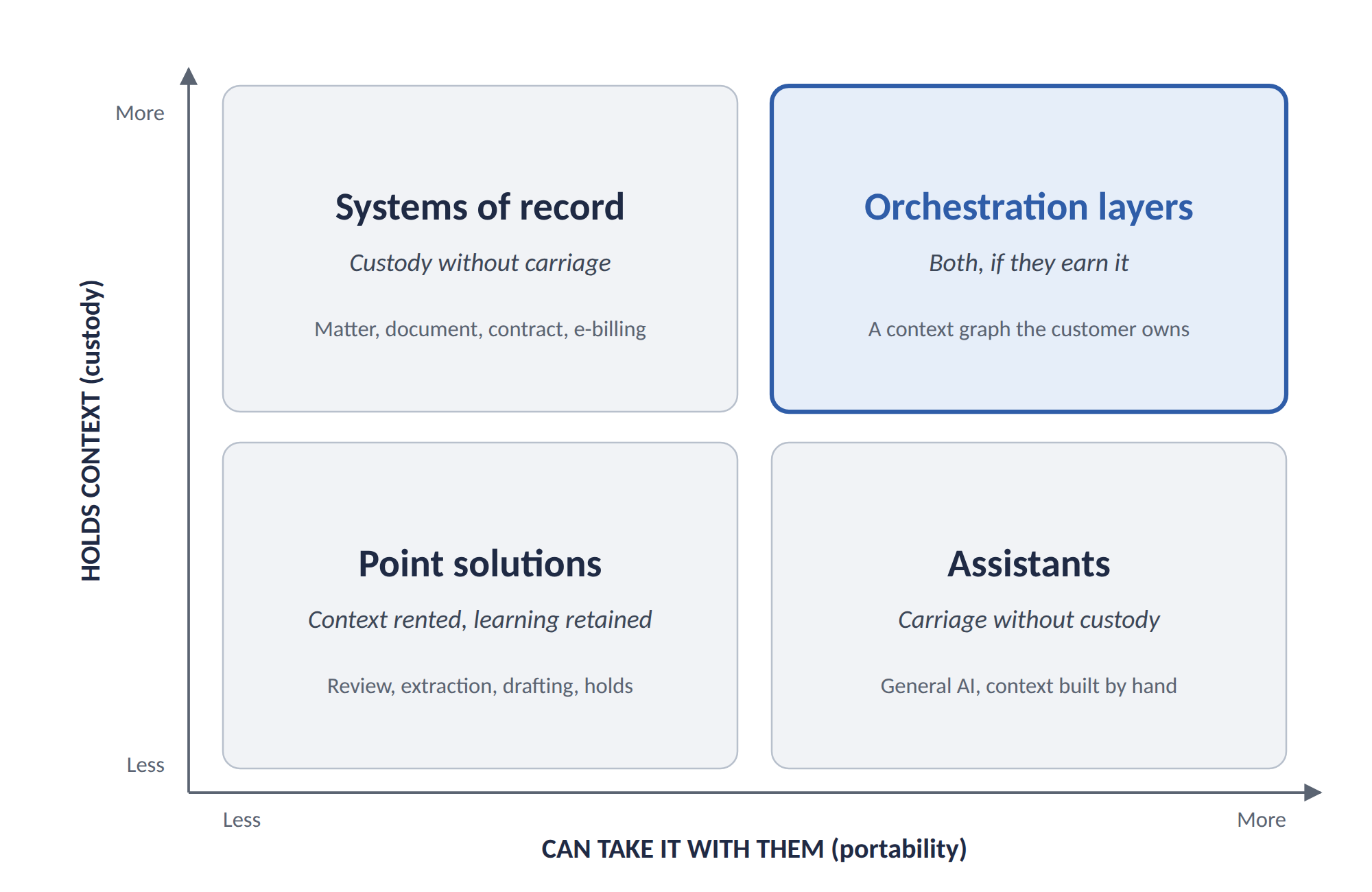
Figure 1. The legal technology market, plotted by custody and portability of context.
Systems of record: custody without carriage
Matter management, document management, contract repositories and e-billing platforms hold more legal context than anything else in the stack, because filings, approvals and payments all pass through them.
They have two limitations:
- They keep outcomes and metadata. Reasoning was never a required field, so judgment context is rarely captured.
- They were built to be filed into, so an assistant has nothing to draw on while a lawyer is drafting.
They can open up, with permission-aware retrieval and open standards, and become the foundation the rest of the stack relies on. If they stay closed, clients will extract their data some other way.
Point solutions: context rented, learning retained
Point solutions are strongest at specific tasks. The best NDA reviewer or obligation extractor beats a broader tool at its own job, and that keeps it in the stack.
Their context is rented. You import a playbook or policy and the tool uses it for one workflow. Every edit teaches it more about your team, but what it learns stays inside the vendor's product. Five point solutions give you five partial pictures of your legal operation and no way to combine them.
This lock-in builds slowly and looks harmless in a pilot. Ask whether your playbook, after a year of corrections, can be exported in a format another tool can read.
Assistants: carriage without custody
General-purpose assistants are the mirror image of systems of record. They spread quickly without a procurement cycle, and they lead on portability: switching between them is often just configuration.
What they hold is thin and personal. Memory, uploaded playbooks and projects help, but everything is maintained by hand and goes out of date quickly. Every user may end up with their own version of a playbook.
The cost comes later. Teams end up maintaining the prompts, files and connections themselves, and the bill arrives when the person who built the setup moves on. That is the senior associate problem again.
Orchestration layers: both, if they earn it
Orchestration layers connect systems of record, route work to point solutions and give every assistant a single view. In principle they can offer both custody and portability.
They can fail in two ways:
- Some are only conduits: easy to replace and holding nothing of their own.
- Others become new silos, copying context into their own store with their own constraints.
The ones that last will treat context as a first-class object: a live, permission-aware network linking contracts, matters, policies and people. They will store the insight nothing else holds and leave the customer in full control. Swap the interface on top. If the answers stay consistent and familiar, you own your context.
What changes for in-house teams and law firms
For in-house teams, the order of decisions changes. First decide which system is the authority for each kind of context and how it connects to the tools in use. Then choose tools. Starting with tool selection means your architecture is decided by whatever you bought first.
For law firms, context is a formal asset and what clients pay for. A firm's deep knowledge of a client's business and history brings repeat work. Expect clients to start asking for matter context when an engagement ends, as they already ask for documents.
Five questions for the next evaluation
These questions show which vendors safeguard your context and which keep it locked in.
1. Systems of record
- What it holds: Deep institutional and matter context; little judgment.
- How it fails: An archive nothing else can use.
- Ask the vendor to: Show an assistant already in use answering from your data, with your permissions enforced.
2. Point solutions
- What it holds: Task context and accrued learning.
- How it fails: Lock-in worsens with every use.
- Ask the vendor to: Export the playbook (with refinements) in an open format.
3. Assistants
- What it holds: Context built by each user or workspace.
- How it fails: Multiple versions, maintained manually.
- Ask the vendor to: Show how shared context is governed, versioned, and remains current across the team.
4. Orchestration layers
- What it holds: Potentially all three types linked.
- How it fails: Either too thin, or another silo.
- Ask the vendor to: Swap the interface or assistant while maintaining consistent answers and context ownership.
5. Every vendor
When we leave, show exactly what we take with us.
Own the context, rent the tools
Products will keep merging and rebranding, but the context map stays stable, because legal work is only as good as the shared understanding of the situation.
Stop treating context as a by-product and manage it as an asset. Know where each type lives and who owns it, then choose tools by how cleanly they read from it and write back to it.

